Experimental facilities

Plate impact
50mm bore Plate Impact Facility. A single stage light gas gun, capable of launching projectiles at up to 1km/s. Initially designed and constructed in the 1990s, and used to determine shock Hugoniot data for a wide range of materials. Nowadays the suite of potential experiments has expanded to include the study of off-Hugoniot, ring-down, release, spall and other related shock phenomena, as well as experiments with more complex geometries.

Ballistic impact
Our "small" light has gun is a separate system with interchangeable barrels. These have a range of bore sizes from 5mm to 25mm and a maximum firing velocities in excess of 1km/s (depending on projectile). Normally the barrel is matched to the diameter of the projectile required, thus avoiding the challenges of "sabot stripping". Target chambers may be evacuated or atmospheric, with a wide array of bespoke options to facilitate novel experiments.

Hopkinson bars
The group has a suite of bars, both compression and tension. We have a wide range of bar lengths, diameters and materials from maraging steel to magnesium. Recent developments range from down-scaling towards “micro” bars, direct impact configurations, non-contact interferometry probes in place of adhered gauges, off-ambient (both heated and cryogenic) loading, and new methods for characterising necking strain under tensile load.

Dropweight & BAM tester
The Dropweight is another in-house designed facility, able to launch a 5.5kg weight under gravity at 5m/s. In a typical experiment a specimen is compressed between toughened glass anvils, producing a maximum impact pressure in the specimen of approximately 1 GPa. Diagnostics include force transducers, a periscopic arrangement to allow for high speed photography (for example to look at hot-spot ignition of energetic materials) through the glass anvils, spectroscopy and mass spectrometry. The BAM tester provides a complimentary "standard" test for energetic sensitivity.

Instron mechanical testing
Our Instron 68TM50 is a low strain rate screw-driven mechanical testing machine. Samples may be tested in tension or compression, and fixtures including peel, multi-point bending and Brazilian Disk platens are available. We have 50kN, 5kN and 500N load cells, suitable for testing small high-strength metal specimens and very soft polymers alike. The attached environmental chamber enables experiments between -100C and +350C. Diagnostics include an AVE2 digital extensometer as well as clip-on gauges and both 2D and stereoscopic Digital Image Correlation (DIC) capabilities.
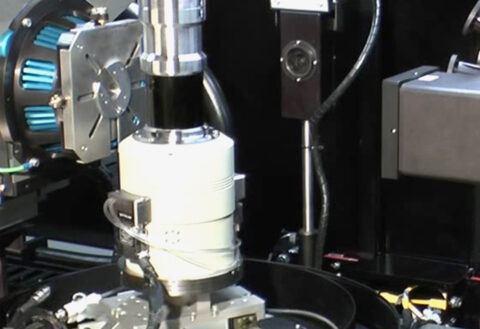
Zeiss 730 x-ray CT microscope
Our most recent addition, only the second in the UK. Capable of achieving a spatial resolution down to 450nm across 30-160 kV (using a 40x Prime objective lens), as well as imaging larger fields of view with 20x, 4x and 0.4x objectives, this is a hugely versatile machine for non-destructive 3D imaging of a wide variety of specimens. Our advanced reconstruction toolbox includes ZEISS DeepRecon Pro and Dual Scan Contrast Visualizer (DSCoVer); and we have a Deben in-situ stage for heating and cooling specimens and applying tensile or compressive loads to 5kN.

Solid particle erosion
The solid particle erosion facility uses compressed air to accelerate solid particles such as sand or silicon carbide towards a target at up to 200m/s. Different barrels are available depending on target area and velocity required. The target chamber is fitted with an industrial vacuum cleaner so that silica dust cannot escape into the laboratory. As well as standard erosion experiments, the facility has also been used to examine phenomena such as light emission from high velocity sand impact on helicopter rotor blades. **Please note that this equipment is currently not in active use.

Liquid drop erosion
The liquid erosion facility houses a Single Impact Jet Apparatus (SIJA) and the Multiple Impact Jet Apparatus (MIJA). The SIJA uses a small gas gun to fire a single pellet into a reservoir of water, which is forced out of the hole as a jet. Owing to the air resistance this jet becomes hemispherical in flight, approximating a raindrop when impacting the target surface. Velocities of up to 1200 m/s can be reached. The MIJA utilizes the same principle, but with multiple shot capability and computer control.

Laser-launched flyer
Our experimental laser-launched flyer system consists of a Q-switched Nd:YAG laser with a half-joule pulse energy, and an array of optics to condition, analyse and focus the beam. The focused pulse falls on a film a few microns thick, irradiating an area of approximately one square millimetre. The high energy density in this region converts a thin layer of the film to plasma, driving the remaining thickness forward at speeds of a few kilometres per second. **Please note that this equipment is currently not in active use.