Research themes
Energetic materials
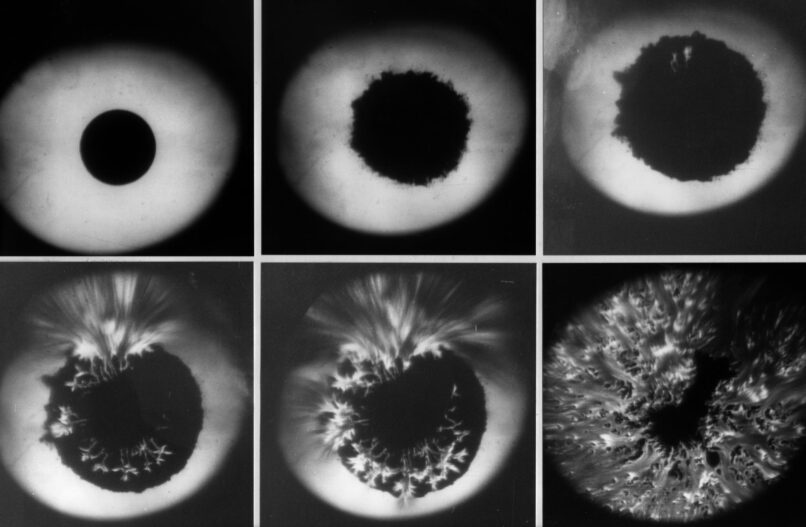
Energetic materials such as propellants, pyrotechnics and explosives are capable of releasing large amount of chemical energy quickly. We aim to develop a much more complete understanding of their fundamental behaviour, developing and instrumenting small scale experiments to support model development. Our work has a particular focus on understanding damage and the implications for explosives safety.
Experimental research includes thermomechanical materials analysis, and studying the dynamic mechanical response under load across many orders of magnitude of strain rate and length-scales.
Fibre composites
Fibre-reinforced polymers can have high specific strength and fracture toughness, and in many applications could outperform tractional materials such as metals, with potential benefits such as weight reduction, improved efficiency and corrosion resistance. However, they are also high complex, anisotropic structures, which deform and degrade via damage accumulation. In order to make best use of them, we need to understand much more about how they work, and how they fail.
We develop small-scale experimental techniques and associated analysis methodologies to understand structure-function relationships in composites, with a focus on strain rate sensitivity and performance under high strain-rate loading.

Polymers
Polymers are a diverse family of materials with a wide range of applications in industries ranging from automotive and aerospace to electronics and medicine. Their mechanical behaviour depends strongly on temperature, strain rate and many other factors.
In our group, we can measure heat capacity (from 25-450 K) and thermal expansion (120-420 K), as well as mechanical properties across strain rates from quasi-static to dynamic, shock and ultrasonic loading. We use our datasets to populate models for structure-property relations of polymers. Group Interaction Modelling, a framework that uses the chemical structure and configuration of the polymer chain to predict its bulk properties, is a particular specialism.
Granular and geological materials
Granular materials – from dry and wetted sand grains to ceramics, rocks, and metallic and polymer foams – share many physical phenomena with fibre composites and energetic materials. They are not simple materials but structures, and they deform, damage and fail via many different processes, all of which exhibit some strain rate sensitivity.
In the past two decades research in this area has considered many different fully dense and porous granular materials; primarily studying structure-property relationships and response to quasi-static, dynamic, ballistic penetration and shock loading.

Metals
A variety of models are available to predict the response of metals in various situations, with varying levels of physical basis. However, strain rate and loading path dependence, and plastic deformation beyond the point of yield, are often much less well understood. This is particularly true for the many new metallic compositions and structures which can now be fabricated using techniques such as additive manufacturing.
Our research aims to design new experimental and analysis techniques to aid in the parameterization of these models. Materials of interest include very high strength steels, titanium, high entropy alloys and other novel metallics.
Other areas of interest
In recent years we have studied the dynamic behaviour of ceramic armour systems, a “space penetrator” (designed to contain scientific apparatus able to withstand impact into Europa, one of the moons of Jupiter), reactive metals, lithium ion batteries, and much more besides.
Our expertise is focused on experimental methods – both high strain rate processes and accompanying thermo- and mechanical materials characterisation. Applications of those experiments are very broad, and lead us to new and evolving interests in a wide range of novel functional and structural materials.