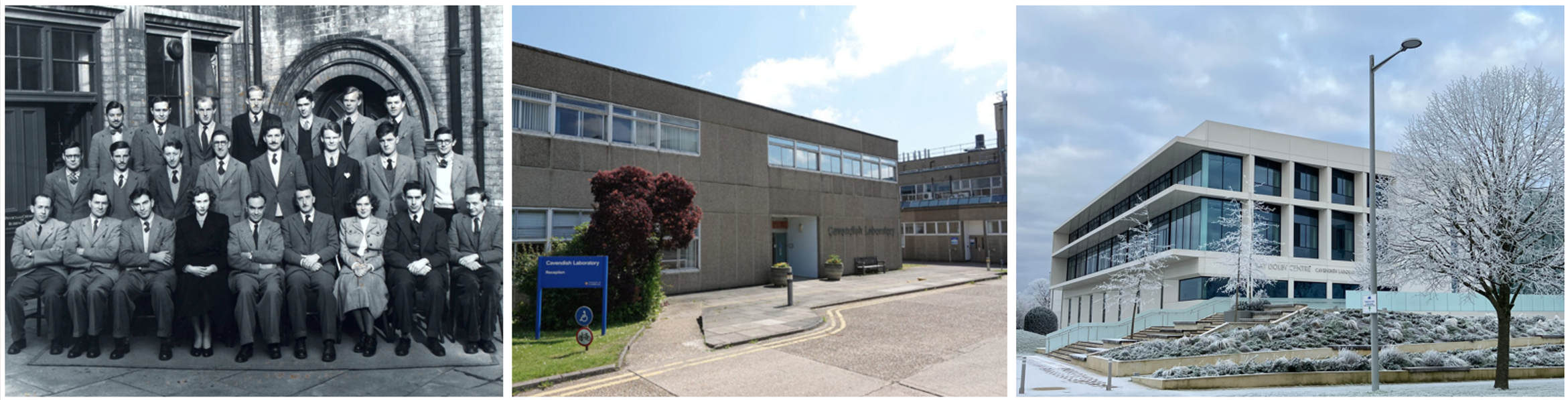
The Physics and Chemistry of Solids (PCS) Group was founded by Philip Bowden (1903-1968). He was of Tasmanian origin and initially came to Cambridge in 1927 to do a PhD in electrochemistry.
In the summer of 1939 he went on a lecture tour of America and combined it with a trip to Australia to meet old friends and family. While he was in Australia, World War 2 broke out. In response he offered his services to the Australian Government, and set up a laboratory at the University of Melbourne to help the Australian war effort, particularly on problems of friction, lubrication, bearings and wear. The lab co-operated with a bearing manufacturer to help produce effective bearings for the newly developing aircraft industry in Australia.
In 1941 he was introduced to another topic that was later to play an important part in PCS after the war ended. The Australian munitions industry was concerned about an unexplained detonation of a vat of nitroglycerine at the ICI factory at Deer Park near Melbourne causing serious damage to the factory and precincts. Abe Yoffe joined the Lab in late 1941 to carry this study forward. The experiments of Yoffe, together with Maurice Mulcahy and Bob Vines, who joined in 1942, led to the discovery of the very large sensitizing effect of the presence of tiny gas bubbles in nitroglycerine. This later led to the publication of the famous book “Initiation and Growth of Explosion in Liquids and Solids” by Bowden & Yoffe, published by Cambridge University Press in 1952. Their conclusion concerning the Deer Park disaster was that it was due to the ‘water hammer effect’ caused by adiabatic compression of gas inclusions in piping leading away from the vat where the nitroglycerine was made. Later research on the initiation of solid explosives by friction led to the concept of ‘hot spots’ as the necessary condition for initiation to occur (Bowden, F.P., Stone, M.A. and Tudor, G.K. “Hot spots on rubbing surfaces and the detonation of explosives by friction”, Proc. R. Soc. Lond. A188 (1947) 329-349).
At the end of the war, Philip Bowden returned to Cambridge and became a lecturer in the Department of Physical Chemistry. He brought with him some of his more experienced scientists from Australia, including David Tabor, Abe Yoffe, Jeof Courtney-Pratt, and Alan Moore. They were soon joined by some graduates from Cambridge and other universities. The programme was very much a continuation and development of work in Melbourne, and it is significant that Bowden called it the Physics and Chemistry of Rubbing Solids (PCRS) Group. The main areas of work were initially friction, lubrication, and chemical decomposition produced by friction and analogous processes. These studies gradually developed to include the erosion of solids by liquid impact, the strength and fracture of solids, the effect of molecular structure on the chemical stability of explosives, and the relation between structure and the optical and electronic properties of solids.
In the early 1950s, Nevill Mott was appointed Cavendish Professor. Nevill Mott was the father of solid state physics in the UK. Although a theoretician, he had close contacts with industry and had been involved in many wartime activities. He not only solved the problem of how photographic processes occur, he worked on dislocations and wrote a seminal paper on fragmentation. He understood Philip Bowden’s interests and approach. They were also both Fellows of Gonville & Caius College. As a result of discussions between them, Philip Bowden resigned from Physical Chemistry and was taken on by the Cavendish. Nevill Mott gave strong support to the lab and encouraged its involvement in the study of the electronic properties of layered materials. In 1957 Philip Bowden was made a Reader in Physics and his laboratory became a sub-department of the Cavendish Laboratory. Its name was changed at the same time to PCS.
In 1966 Philip Bowden was given a personal chair in Surface Physics, so for a time the lab was known as Surface Physics. Philip Bowden died in 1968. His obituary was published in the Biographical Memoirs of Fellows of the Royal Society. A full list of his publications is available here. A link to an article published to commemorate the centenary of Philip Bowden’s birth and reviewing his contribution to the Australian war effort may be found by clicking here.
Bowden’s lab was the first University group that was interdisciplinary in its research (long before that word was invented). This initially gave rise to some problems, particularly in relation to teaching, supervisions, and examining; but these were gradually resolved. However, there were few difficulties about research funding because of Bowden’s wise choice of research themes and because of the confidence that industrialists had in his projects. One might in fact describe Philip Bowden as a scientific entrepreneur. He was extraordinarily successful in winning the support of Industry and Government departments.